
How do YOU relax? (owls).
.&layout=none&ref=https://www.dmackdimages.co.uk/blog/2014/1/how-do-you-relax-me-owls)
“How do YOU relax?”
That was a question put to me by two prospective managers at a job interview I sat through almost seven years ago.
At the time I thought it was a strange question to ask.
Certainly to ask in a job interview.
I don’t regard it as strange now.
I regard it as quite an important question.
If memory serves me correctly, I think I answered along the lines of “I take photographs” (I had just bought my first camera then) “…and sometimes I like to draw”.
But that’s not really how I like to relax.
My father is a pretty impressive both physically and mentally. A big man with a big personality.
He can be (or certainly could be) pretty fiery and I remember a powerful, bold clay sculpture he created 40 or 50 years ago that sat on our mantelpiece at home during my childhood.
He has returned to Scotland now and amongst other things, he paints watercolours.
Landscapes mainly.
I’ve never been that into watercolours, (I’ve blogged on this website before that I’ve often found them apologetic, slightly insipid, weak, twee).
Now my father’s watercolours are very good, but I wouldn’t have expected him to choose that medium for his art.
I asked him once why he chose watercolours. Why not the bolder oils or clay or acrylics or wood?
He looked me very carefully in the eyes and said very calmly:
“This is how I relax. I find painting with watercolour relaxing”.
I don’t think I understood then.
I do now.
Absolutely.
But whilst my father might have passed some of his artistic ability down to me and my eldest sister, I don’t relax by painting. Watercolours or not.
Not yet.
I do relax by disappearing (literally disappearing (melting into)) into the countryside. Generally alone (sometimes with my wife now I guess) and I just listen and watch the wildlife around me.
As I’ve told a few people recently, the(ir) camera (and the(ir) photos) is (are) almost irrelevant.
It’s the moment that counts, the actual sight and sound of the wildlife around me (or them) – not the fact that I’ve (or they’ve) managed to capture anything “on film” generally – although I still do occasionally try.
My local disappearing acts, now, at this time of year, are centred on our local owls I suppose.
Sure… swifts are my one true avian joy but there’s something absolutely fascinating about owls and anyway, the stupendous swifts have not been in Berkshire for 6 months now. Instead they’ve been in the Congo for that time and won’t be back here for three months or so.
Owls are… you know. Different.
Rather like two of my favourite other birds, nightjars and (of course!) my swifts, owls don’t seem the same as other birds and they’ve appeared that way to us humans for hundreds if not thousands of years.
Throughout human history the owl has been looked upon with fascination and awe.
They’ve been both feared and venerated, despised and admired & considered wise and foolish.
Owls abound in Greek and Roman mythology and English folklore is littered with superstition regarding these birds.
There are ten (I think) species of owl on the British Ornithologists’ Union “British List”, (a strange list of birds detailing every species that has been seen in Britain).
Should there be anyone reading this who would like to hazard a guess at all ten species, I’ll only reveal the full list of ten at the very bottom of this lonnnnnng post.
Until then, I’ll briefly deal with my personal experience of four of the six species that can claim to be on the “practical British list” – owls that one might actually have a chance to see these days.
This list comprises of the Short-eared owl, Tawny owl, Little Owl (introduced), Barn Owl, Eagle owl (re-introduced) and Long-eared owl.
I’ll write about the first four of this list.
Short-eared owl.
All owls are stunning in my view, but the short-eared owls’ faces take the biscuit.
An owl that often can be seen hunting during the day (or at dawn and dusk – making it at least partially crepuscular) it therefore has yellow eyes with a smaller pupil than the darker-eyed barn and tawny owls – very nocturnal in nature both of them.
Short-eared owls look like they’re wearing heavy mascara close up.
Beautiful things.
I had never seen a short-eared owl (I don’t tend to go “looking for specific birds” the way “birders” do and find northern uplands to be dark, treeless, soul crushing places) until I moved back out of London in the “noughties” with my soon-to-be wife.
Short-eared owls tend to breed on northern uplands (but even they can’t hack those soulless moors during the winter) so fly south and overwinter on southern heaths and rough ground. I had been told of a spot (by an old boy who certainly knew his stuff) within twenty miles of Reading which held two dozen or so short-eared owls.
That particular site has been virtually annulled by “birders” and “twitchers” and “bird-racers” now, thanks to the nascent inability (or unwillingness) of the online world to keep bird reports out of the hands of selfish, unthinking “birdwatchers”.
I heard that weekend after weekend during recent winters; the owls had their winter headquarters inundated by “birders” trying to get their glory-shot of these beautiful things.
The owls are still there I hear.
But in far fewer numbers than they were.
This was not due to climate change or having their habitat built on.
It was due to the short-sighted “birders” that so often complain about lack of habitat or climate change, upsetting (en masse) these sensitive birds.
A real shame – and food for thought for anyone who calls himself a “birder”.
I was also once fortunate enough to find a short-eared owl quartering over flood meadows at my local “patch” when Anna and I lived in Reading a few years ago. I was out on one of my walks on the look out (and “listen-out”) for barn owls and winter waders (snipe and woodcock).
I think I am still the only person to have ever recorded (perhaps even seen) a short-eared owl in that particular piece of land – but it was only there for a day. Luckily I was lucky enough to photograph it from a distance, with a prominent local landmark in the background, in case any county-recorder needed proof (I got the feeling they did need proof – something I absolutely agree with).
I do know of another site within a short(ish) drive of our house in southeast Berks these days, where I could find another good population of short-eared owls overwintering down south, but I don’t feel the pressing need to see them at present. I don’t need to be part of the “weekend Swarovski gang” right now (nor could I afford to be!), so I’ll leave these owls to the anoraks and just hope they give these pretty-faced owls enough space.
Tawny owl
My first memories of tawny owls (like many) were the “twoooo-oo-ooohs” and “ewweets” heard in parks and woodlands (I grew up in the Chiltern Hills) on most nights.
Aged around ten, my paper-round brought me into contact with these stunning creatures (the prettiest owls of all I think, in terms of plumage if nothing else).
I often used to take the front light off my bicycle handlebars to shine up at wide-eyed tawnies in a big tree at weekends. That was only after I had spent the penultimate dark hour of Sunday morning cramming encyclopaedia-sized Sunday Times newspapers (with multiple supplements) into the cigarette packet-sized letterboxes of the residents of leafy, north High Wycombe.
A little older and I became a member of BBONT or “Bucks, Berks & Oxon Naturalists’ Trust) as it was then (BBOWT now) and badger-surveyed a few woods for them.
I’ll never forget surveying a mixed wood in the deepest, darkest Chilterns one summer’s day (middle of the day) and watching a tawny (that I’d probably inadvertently disturbed at roost) fly slowly, deliberately and silently through the green canopy ahead of me to find a more peaceful spot to get some shut-eye.
In common with barn owls at least, the silent flight of a tawny is really quite eerie – unlike the wing clapping pigeons and even the tiny birds like blue tits, which beat their wings so quickly they make much more noise than a big owl.
That tawny remains the only tawny that I’ve ever seen during the middle of the day.
I spent many evenings (and nights) during my teens and twenties badger watching (I still feel very, VERY, much “at home” in woodland, even at night) and on many of these badger watches, I was treated to tawnies perched a few feet from my still, silent form.
I have even managed to capture tawny owl on trail cameras, twice. Once when I set the trail camera in place to record little owls (see below) and once (I’ll come onto this) when I set it in a spot for barn owls. It is not at all common for a wild tawny (a creature of woodland mainly) to be captured on trail camera away from its nest.
Unlike other species of owls (again… which I’ll come to in a second), tawnies aren’t reknowned for their reliance on a particular perch on a tree – just the tree itself and you (of course) need to point your trail camera at a specific perch if you want to capture an owl on your footage – you just have to hope that your owl alights on that perch to be filmed.
I do think tawny owls are perhaps my favourite of our British owls.
Maybe other people might say the ghostly barn owls (I can see why) or maybe short-eared owls, but look closely at a tawny (at a falconer’s exhibition for example) and marvel in its quite spectacular plumage.

I think I still have my one tawny owl feather (with soft trailing edge which gives the owl its silent flight) in my old golf bag in the shed. I hope so. I seemed to give up golf when I became married! I’ll check later.
Little Owl.
Regular visitors to this website will know I’ve been following the local little owls for a couple of years now ("Operation noctua") and have been lucky enough in that time to get some half-decent photos and some pretty HD impressive video clips of these funny little frowners.
You can see my video clips of little owls here or on you-tube also.
With ALL my video clips please manually select a quality of 1080pixels for maximum HD sharpness.
I’ll not go into all my to-ings and fro-ings regarding our local little owls as you can also dip into my blog archives to get a flavour of what I and they have been up to together during the past two or three years.

A non-native small owl of course, is the little owl, but unlike many other introduced species, the little owl seems to fit right into our British ecosystems without causing untold damage.
My first encounter with a little owl was again in the Chilterns, on a large piece of barely (barely not barley) used farmland.
I was listening to and watching pretty yellowhammers on a suspended phone cable which led to the old farmhouse when I heard a noise I hadn’t heard before. Sounded a bit like the plaintiff mew of a cat –but there just couldn’t have been (a cat), sat in the small copse (formed in and on a Second World War bomb crater) where the mew appeared to come from.
A protracted investigation resulted in the little owl bounce bounce bouncing away from me over the fields and I was very pleased to have seen such a bird up on “my” farm. I guess that was over 30 years ago now. (I’m errr…. 31 now. Cough).
Little owls are funny wee things.
Their facial plumage always makes them look like their fiercely staring at you or frowning with their huge yellow (hunt in daylight just as much as night like short-eared owls) eyes and pale “mono-brow”.

Very often little owls will go after beetles and worms – and can certainly scamper over the ground like little sprinters if they spy a juicy annelid. (See the scampering in the video clip below).

By the way, if the worm tries to escape (you would, wouldn’t you?) , occasionally the determined little owl will pull and pull and pull the worm from its earthy retreat … and if successful, out pops the worm with a “thrup” and over topples the owl onto its back.
I’ve seen this happen three times now, so I don’t suppose its rare behaviour.
Just rarely seen.
My closest encounter with a little owl occurred on the Mediterranean.
Anyone reading this who’s been fortunate enough to take a holiday on the Med (and is interested in anything else than just trying to get a tan) will know that there are plenty of little (and scops) owls in and around Mediterranean villages.
I remember in 1989 when I was holidaying with my twin sisters in Pissouri village (near Paphos in Cyprus), we spent an evening in a crowd of villagers, necking wine and noisily Greek dancing at a grape festival in the village square as a little owl bobbed up and down on one of the taverna’s roofs overlooking us.
It was like it was enjoying the festivities with us (of course it wasn’t!).
But that wasn’t my closest encounter with a little owl.
That came on the green Greek island of Kephalonia nearly twenty years later.
My fiancée (then) and I were in Kephalonia in the late nineties.
We had rented a villa (well… a bedsit with a balcony really) at the top of the hill between Argostoli (the island’s capital which has a fisherman’s café which serves the best fish and lemon potatoes I’ve ever tasted by the way) and Lassi.
I was, as is usual, up each morning at 4am (more on that below), sitting quietly on our balcony, in the dark, with a mug of coffee and a packet of Regal cigarettes.
Just watching the twinkling lights of the Lassi strip below on the coast.
My “me time”.
On the first morning of our two week holiday, there I was, at 4am with my coffee and cigarettes (I’ve stopped smoking now by the way) and PLOP! A ball of fluff alighted on the balcony rail, not 5 feet from me in the darkness.
I couldn’t make out any detail of my feathered friend – it was just silhouetted against the moon’s reflection in the Mediterranean our hillside villa overlooked. But I knew it was a little owl.
I remained motionless, with my cigarette curling up smoke from the ashtray to my side – and only after about twenty seconds, the owl suddenly realised it wasn’t alone and launched back off into the darkness.
After that, each morning I sat there, with my camera set on a tripod and a radio trigger in my hand, hoping that the little owl would return and I’d get a super shot (for my then fiancée, now wife) of this wee thing sitting on the balcony rail.
It never returned.
As for Britain, well I happen to think the our farmland or managed land (little owls preferred choice of habitat rather than scrub or forest) would be far poorer without these “fierce little scamperers” – but I hear they’re not doing as well as we all thought they might be doing…. I do hope that changes.
Barn Owl.
I’ve blogged about barns owls quite a few times before on this website, so I’ll avoid repeating myself. You can read a couple of those blogs here but especially HERE.
They are stunning creatures, that’s for sure, and I am so spawny to have at least three (occasionally) in my local patch of countryside to gaze at.
Even though I’ve written (above) that tawny owls are perhaps my favourite British owl, I can certainly understand why if one was to poll the British public on what their favourite bird was; many would perhaps say a barn owl would be – far more than would say a tawny I expect.
Barn owls are schedule one birds, meaning that they are protected by law at all times, in every month.
This is especially important protection for barn owls as they have been known to nest in most months of the year (if the winter is mild enough for example), but many people still consider the “danger of disturbance period” to be their more traditional nesting period of May to July perhaps.
Truth is many owls have re-established relationships or paired up very early in the year and a disturbance pre-nesting (February say) might be just as damaging as a disturbance in May.
This is one of the reasons I still report my barn owl sightings to the county recorder but only in a confidential (not a publicly visible) fashion.
Now I’m quite well known for shooting videos and taking photos of little owls, but I am always very conscious of the law regarding such actions when watching the local barn owls.
Little owls are non native and not schedule 1 birds.
Not so with barn owls.
I tend to leave my camera and trail camera in the rucksack or car when I’m getting to know the local barn owls – I certainly have no desire to disturb them as just the sight of these owls is a real treat – I feel incredibly fortunate to have them so close to our house.
Regular visitors to this website will know that I delight in taking pre-dawn or dawn drives and walks around my local countryside. Two decades of bakery work and other shift work have saddled me with an unfortunate ability to generally refuse sleep after 04:30am – even on days off.
I haven’t used an alarm clock in years.
There is only one advantage to this particular curse – it means I invariably get the countryside and the wildlife to myself before and during dawn.
Humans don’t tend to do dawn (they much prefer dusk) and wildlife certainly takes advantage of that.
I have spent the last two and a half years getting to know the countryside around our house very well around dawn – and I have little doubt that these hours I have put in have made all the difference when it comes to seeing the three species of local owls (tawnies, barn and little), getting to know their habits and indeed filming little owls with a static trail camera.
To that extent I have found three barn owl roosts locally (all in gnarled old trees) but tend to keep my distance and try to ascertain their habits – their preferred perches, their preferred hunting meadows, when I’m likely to see them, when I’m not likely to see them, etc etc…
Little owls are relatively easy. They have favourite perches for a week or two, then move on and find another favourite perch. And very often these perches are in direct sunlight – little owls love to sunbathe (see video below).
All you need to locate little owls and their favourite perches is a keen set of eyes and a little patience.
Tawny owls are far more difficult.
Sure there are more of them, but they are nocturnal birds (dark eyes), far more arboreal and hidden from view if not from our hearing.
Please watch my clip below for my first accidental video clip of a tawny owl, taken with a little owl set up trail camera.
Barn owls are the “middle owl” for me. Hardly any of them around, but when you are lucky enough to find one (or three!); they often seem to have favourite perches and are often forced to hunt at dawn and dusk (as well as in the inky nights). Barn owls are also pretty easy to see at distance too of course, providing you don’t mistake them for a weird white gull (I did once).
The most annoying thing about following barn owls’ movements is that they are incredibly transient birds, especially in the winter. Barn owls in the UK are at the extreme northern edge of their range (they don’t really do rain, wind or snow) and need to move around just to keep finding food (voles invariably), food enough to survive.
Very often round here, I’ll be keeping tabs on a couple of owls during the winter, only to find one buggers off for a month and the other moves to a different part of the farm.
It’s never dull with barn owls.
They don’t half keep you on your toes.
This weekend (just gone) I located my third barn owl roost, locally.
I had been trying to locate this roost for some time, having had nightly sightings of this particular owl at the farm and finally I happened across its tree (I saw it leave the hole in the tree from my car).
This was a result in itself, but it also meant I could perhaps leave my trail camera near a perch which I knew this barn owl used, about a mile away from its roost.
Schedule one birds must not be accidentally or recklessly disturbed by “birders” or well-meaning (honest) “photographers” (purely after their glory shots) “at or near their nest or roost”.
A black LED trail camera carefully hidden in a bush a mile away from the owl’s roost would not contravene this law (the 1981 Wildlife and Countryside Act).
So on Saturday afternoon I hid the trail camera by this barn owl’s perch (it has about three favourite perches that I know of) and hoped.
I hoped, but didn’t expect much.
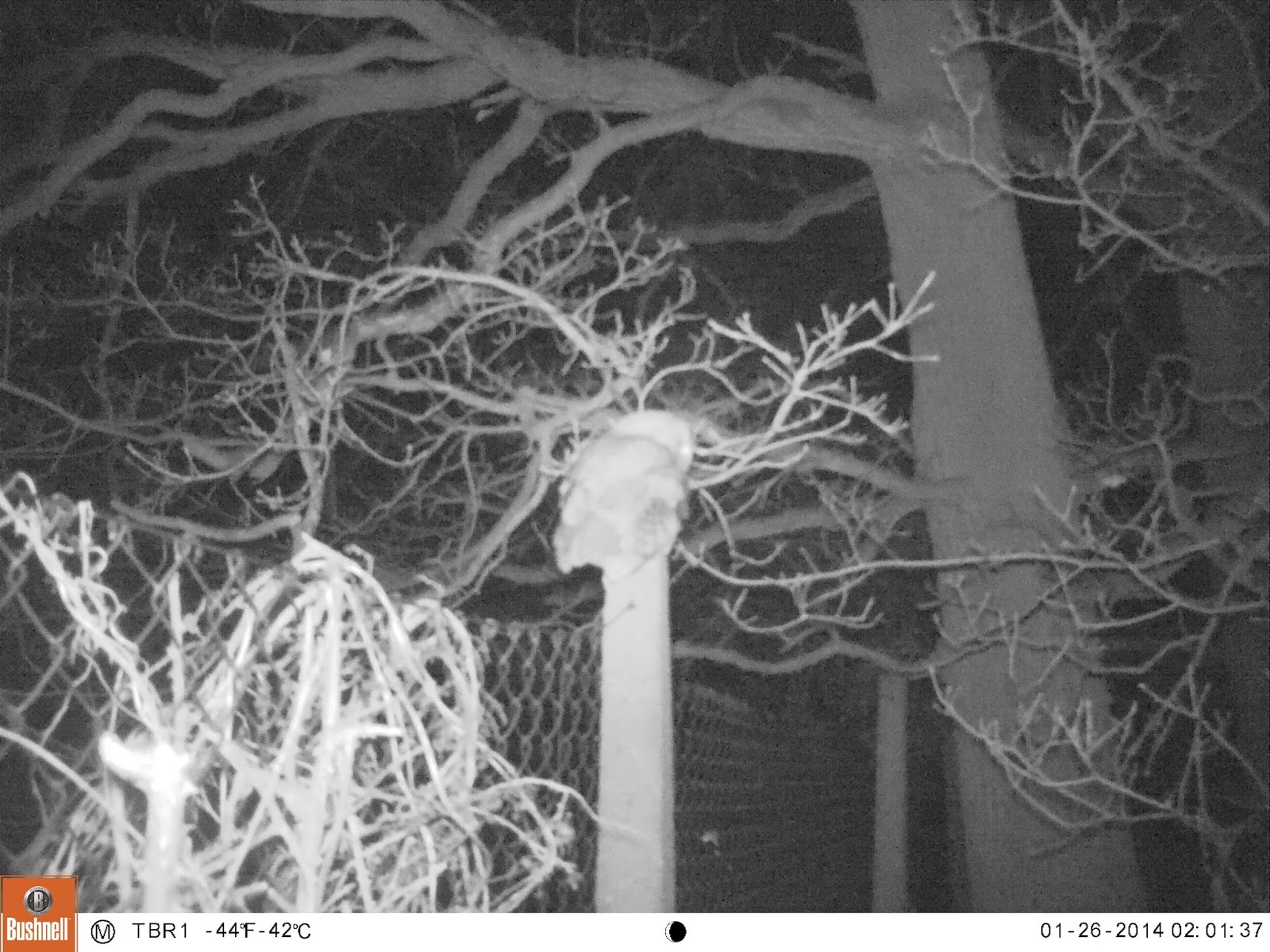
I returned to collect the camera at dawn – and I had been lucky enough to catch the barn owl on the perch, a number of times (as early as 6pm and as late as 2am) but not only that – I had also captured footage of a big tawny sitting on the same perch (at a different time to the barn owl of course)!
Quite often with wildlife photography and sometimes trail camera work, one has to be exceedingly patient before getting anything of note “on film” – even after putting in months and months of preparation and knowledge-building, as I have with these owls.
So to get such a result on the first night of “barn owl cam” was something else!
I’ll not post the video clips here yet.
Why not?
In common with many Bushnell trail camera video clips, if you’re lucky to have had the camera trigger in time (Bushnells have a diabolical strike rate) the actual quality of any footage is appalling (I’d NEVER recommend anyone buys a Bushnell trail cam despite what others might say), but the photos below are stills taken of the barn owl (first) and tawny owl (second) on the same perch, from the same trail cam.
NB. I have a week off at present and will be returning with the trail cam (or another model) to try and get better quality videos of these owls at night, so watch this space.

I’m very conscious that I’m lucky enough at present to have superb eyesight and pretty good “awareness” of the wildlife around my local countryside.
My wife shares my eyesight I think and I know my eldest sister and father are similar.
Add that to the fact that I like nothing more than losing myself in my pre-dawn wildlife drives or walks and have spent weeks if not months being fortunate enough to really get to know or local owls.
There is only one small problem with all this.
Even though I am very happy alone (I don’t do loneliness) and also tend to see more alone, I’d really like to share my knowledge of these owls.
That said, having had bad experiences of “birdwatchers” with the local short-eared owls (see the start of this post) and also last year here with the local barn owls, I tend to not trust the people who used to email me regularly and ask if I could help them see these owls.
I’ve had to apologise to quite a few “birdwatchers” over the past two years and explain to them that due to the actions of a few of them, I wouldn’t be able to help them.
If they wanted to see barn owls, then they’d have to look for themselves I’m afraid. (They wouldn't have much success I would think... they tend not to share my eyesight or awareness).
But to stop the emails and to try and protect these owls, like I’ve written above, I’ve stopped making my barn owl records public.
But you know... I still do want to share these beautiful sights.
As a biologist (or at least as a person who read zoology at university) I regard the purpose of life to be to be to continue life. Very simple.
But as a “human being” if someone was to ask me what I regarded the purpose of our life to be, I’d probably suggest something along the lines of:
“The purpose of life is to share one’s life, with friends and /or family”.
And that’s all.
Nothing else.
(You can make of that what you will… I can’t really answer the question!)
One of my strongest and happiest childhood memories was sitting in my father’s car, as he drove ‘round the local countryside (the Chilterns) as well as parts of Scotland.
The wildlife we saw on the country roads held me spellbound.
These days, 35 odd years on, I always seem to be the only one up at 04:30am – my wife is certainly asleep at that time, as is my 14 month old son.
So sharing these sights and experiences (with people who don't label themselves as "birders" or "twitchers") is difficult.
But.
I hope that one day….
Maybe within a few years?
My son might like to take a drive with me around the local countryside and spot the owls and local beady-eyed beasties with me.
Rather like my father (I expect).
I’d love that.
Until then, I’ll keep keeping tabs on our local owls alone.

Now.
Regular visitors to this website may know that my health has not been the best for the past couple of years, for reasons which I might blog about as soon as I feel comfortable doing so.
All through the dark weeks and months over the past two years, the local owls have been a source of huge comfort to me, especially during the seasons away from the summer, when my greatest British wildlife delight, my swifts, are gone.
Stupid I know, but when my wife becomes a temporary “owl widow” (“are you off to see the owls again?”), she knows I’m getting my fix of the wild - and it’s healthy for me and her.
When “my” local owls are around, I get the feeling that all is well with the world.
I know it’s daft, but that’s how they make me feel.
Yes.
You may be different.
You almost certainly are.
You may relax by watching the snooker on the box.
Or by cooking.
Or by reading “whodunnit” novels.
Or by painting watercolours perhaps.
But this is how I relax.
Footnote.
The photo below is of a Scops owl. Like little owls, the Med is full of these wonderful wee owls.
As the sun goes down, Mediterranean trees become sources of strange, rhythmical frog-like calls. But these aren’t frogs – they’re the beautiful scops owls.
I shot the photo below in my favourite holiday destination in the world.
You can read about that place (should you want) here. But please keep its location a secret. Anna and I never want it to change!
TBR.

Final footnote:
For those who wanted to try to guess the ten species of owl on the BOU British list… they are:
Keep scrolling down….
Tawny owl
Barn owl
Short-eared owl
Long-eared owl
Little owl
Snowy owl
Tengmalm’s owl
Hawk owl
Snowy owl
Eagle owl