
- About
- | All my images
- | Wildlife blog
- | Zoo names
- | Website news
- | Links
- | Guestbook
- | Contact
The wonderful world of moth antennae

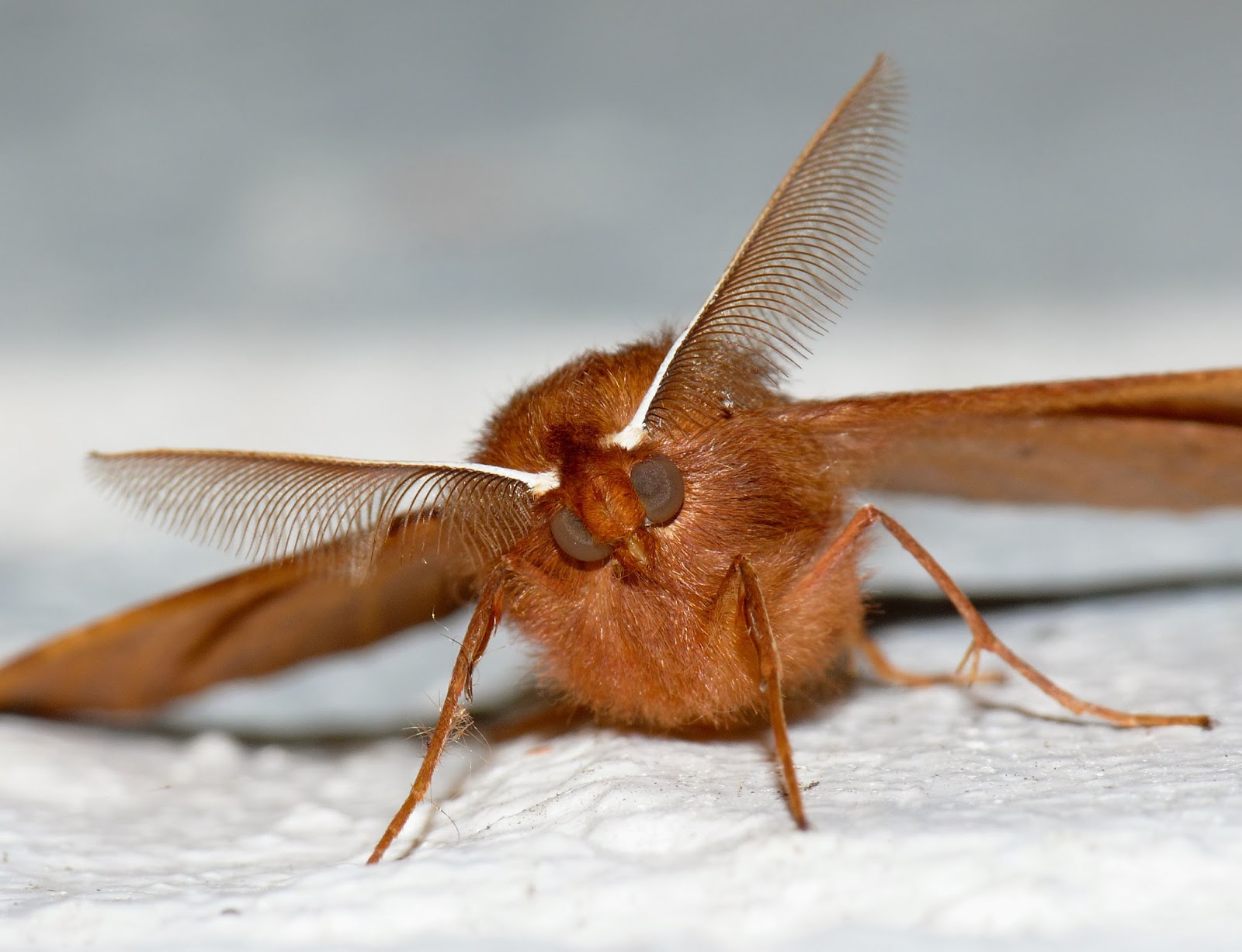
We've been visited by a pair of male feathered thorn moths this past fortnight. These moths fly late in the year and now seem reluctant to leave the shelter of the passageway by our back door.
They're pretty wee things - each displaying a set of rather impressive feathery antennae.
In fact, the males' antennae gave these moths their scientific name (colotoise (beautiful (mis.)) pennaria (feathered)) and their common English name of Feathered thorn.
I took a few photos of these moths (concentrating on their antennae) below (all photos are mine) and thought I'd write a quick few words on the amazing moth antennae.


Male moths often have large feathery antennae - especially those in the saturniid, bombycid, and lasiocampid (such as the lackey below) families. The feathered thorn is part of the Geometrid family, but exhibits large feathery antennae also.
It's a handy way to tell butterflies and moths apart - butterflies have thin, clubbed antennae whilst moths have thin, unlcubbed antennae and some male moths have these superb feathery antennae instead.

Why are they so impressively-feathered though? What's the point of all that surface area?
Just that.
Surface area.
The male moth is only after one thing generally..... a mate - and with a large set of feathery antennae, he can sniff out a female moth's pheremones from kilometres away. In fact so powerful are his olfactory senses, it borders on supernatural. Some male moths have 60,000 olfactory receptors on their antennae - and can pick up a single molecule of female moth pheremone in a cubic yard of air - up to 11km from the female emitting these pheremones.
Using both antennae "smelling" as much air as possible on the large surface area of his feathery antennae - the male moth can tell in which direction the female is and flies off to find her.
We can't smell these moth pheremones, but the male moth certainly can - at ridiculously low concentrations. Makes sense to have this sort of sense really, if you fly at night and can't see or hear any prospective mate, eh?
But that's not the sole purpose of these antennae.
Nope.
They're multifunctional!
Flies have specialized structures called halteres behind their wings. These fly "gyroscopes" beat at their wing-beat frequency (approximately 100 times per second) and also have special touch sensors that sense changes in flight.
The halteres constantly send messages through neurons to change flight muscles and wing motion to alter where the fly goes.
But moths use their antennae in the same way - as halteres or gyroscopes. To provide flight stability.
When placed under a microscope, a moth's antenna looks like a string of beads. Most of this "string" is covered with hair-like odor detectors used for locating food and mates.
The joint where the antenna attaches to the moth's head is very flexible and has special touch sensors that control the position of the antenna and tell the brain about antennal movements.
When the moth is flying, its body bobs up and down with each wing beat, just like humans do when we walk.
The touch sensors at the base of each antenna report this regular bobbing to the brain.
This regular signal changes when the moth encounters in-flight turbulence that could send the moth off course. When this happens the moth makes a course correction and stabilizes its flight pattern.
This research is being used to look at designing small gyroscopic vibrating antennae for tiny robotic autonomous flying machines the size of birds. (I kid you not). At present we can make gyros for large passenger planes without too much fuss, but we are some way short of making gyros for tiny planes.
Moths figured all this out a long time ago.....
Note.
All the above photos are of the male feathered thorns this week.
The shot below is one I took of a male lackey moth three and a half years ago.
